

to leave a comment.
Hello, everyone! I'm your energetic guide, a 30-something female senior analyst and blockchain tech influencer! Today, I've prepared a bright and energetic market commentary, coolly analyzing the hot news of the past 24 hours based on facts. Let's unravel these complex market situations easily and enjoyably together!
Recently, global financial markets have been closely watching the situation in the Middle East. The news of a dramatic two-week ceasefire agreement between the U.S. and Iran brought immediate relief to the market, igniting a preference for risk assets. As oil prices plummeted and U.S. stocks surged, the cryptocurrency market, including Bitcoin, also seemed to regain vitality after a long time. However, whether this peaceful atmosphere will last remains to be seen. Tensions are rising again as Iran claims violations of the ceasefire agreement, blocking passage through the Strait of Hormuz and seizing oil tankers.
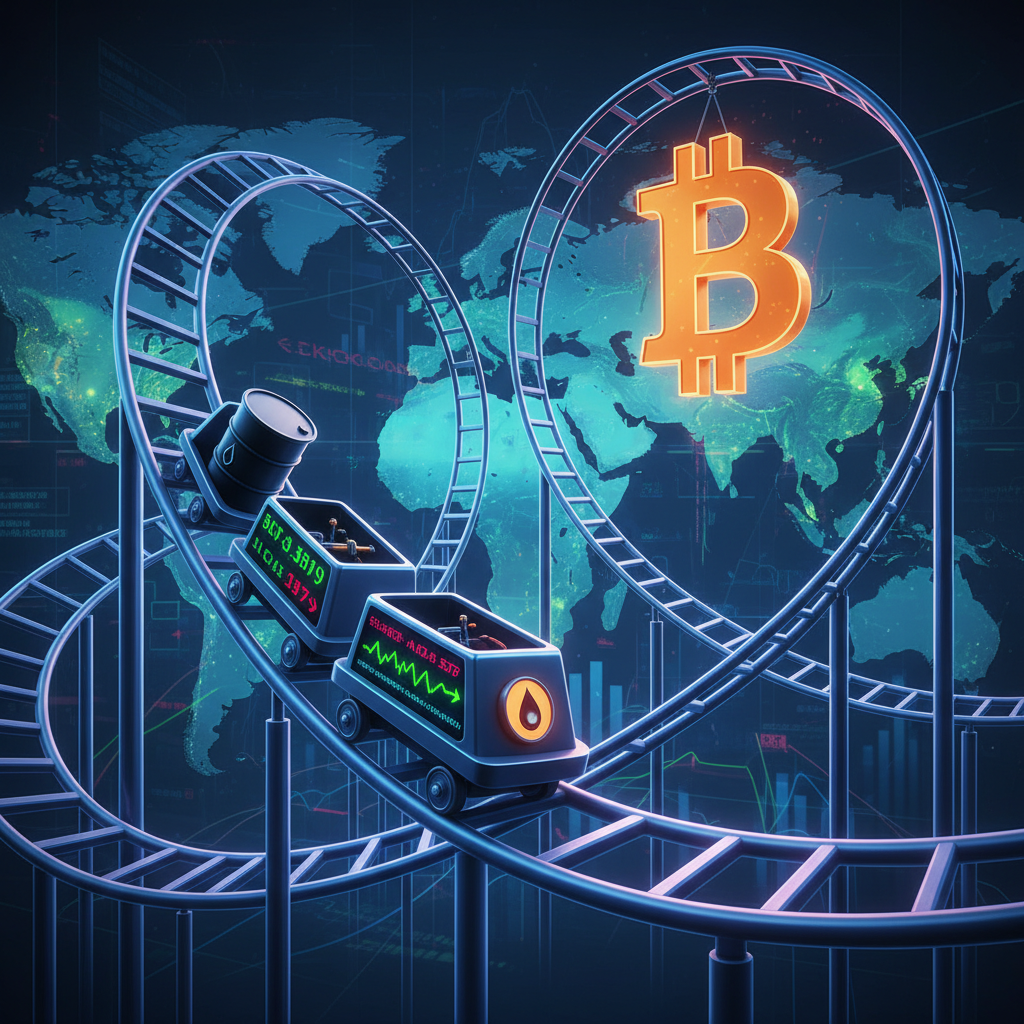
The news of the U.S.-Iran ceasefire agreement was truly dramatic. Oil prices plummeted by 16%, and the three major U.S. stock indices all closed higher. The cryptocurrency market also followed suit, with major assets like Bitcoin, Ethereum, and XRP all surging.
However, anxiety is once again spreading through the market with reports that Iran's Revolutionary Guard blocked passage through the Strait of Hormuz and seized oil tankers, citing Israel's violation of the Lebanon ceasefire. Furthermore, reports that Iran might collect Strait of Hormuz passage fees in Bitcoin or Yuan have further amplified the impact of geopolitical risks on the cryptocurrency market.
The uncertainty in the Middle East also acts as a 'two-way risk' for the Federal Reserve's interest rate path. The possibility of a shrinking labor market due to war suggests rate cuts, while inflation risks point to rate hikes, leading to differing opinions among Fed officials. Currently, the probability of an interest rate freeze in April is very high at 98.4%, but it's important to note that this could change at any time depending on the situation in the Middle East.
Following the news of the Middle East ceasefire, Bitcoin broke past $71,000, showing a strong rebound. Over the past 24 hours, short positions worth an astounding $600 million were liquidated, with buying pressure flowing into the market driving up Bitcoin's price. This is a positive sign, indicating that excessive short positions accumulated in the market were cleared all at once.
Furthermore, the positive news includes Morgan Stanley, a major Wall Street investment bank, listing a spot Bitcoin ETF (MSBT) on the New York Stock Exchange, attracting approximately $34 million in funds on its first day. This signifies increased institutional investor entry into the Bitcoin market, and we can anticipate further capital inflows in the future.
However, a cautious approach is still needed. On-chain analysts suggest that despite Bitcoin recovering $70,000, there is a lack of strong conviction in its upward trend due to sluggish spot demand and reduced futures trading activity. Additionally, the number of addresses depositing Bitcoin to exchanges hitting a 10-year low indicates either a shrinking market activity or investors opting for a long-term holding strategy. We can only be confident in a shift from a bear market to a bull market once Bitcoin stably breaks past $80,000.
Driven by Bitcoin's strength, Ethereum and major altcoins also showed a rebound.
Ethereum has broken past the $2,200 resistance level, forming strong upward momentum. Whale investors have started accumulating Ethereum, leading to a price rebound. This is a good sign that long-term confidence in Ethereum remains high.
However, caution is still observed in the derivatives market. There was also news that the Ethereum Foundation plans to convert 5,000 ETH into stablecoins for research and development and grant funding. While this can be seen as a measure for sound financial management, it could act as selling pressure in the short term.
XRP experienced strong capital inflows with the news of the U.S.-Iran ceasefire, surpassing Bitcoin and Ethereum to rank first in ETF capital inflow. SBI Ripple Asia's move to expand its market with an XRP Ledger-based token platform is also expected to positively impact the XRP ecosystem.
There are also analyses indicating that XRP investors' average loss rate has fallen to minus 41%, suggesting an 'all-time low signal.' This could be an indicator for a strong long-term rebound. However, there are also signs that it's too early to confirm a trend reversal. A genuine upward rally can only be expected once the $1.40 resistance level is decisively broken.
Cardano (ADA) is showing a strong rebound with an increase in whale addresses holding over 10 million ADA and a 79% surge in weekly trading volume. News of budget reallocation for ecosystem expansion is also positive. This is a good sign that the Cardano ecosystem is becoming more robust.
Memecoins like Shiba Inu (SHIB) and Pepe (PEPE) also attempted a rebound in line with Bitcoin's upward trend. In particular, Shiba Inu is raising expectations for an aggressive upward scenario with a surge in its burn rate and a 'supply shock' phenomenon observed as exchange holdings decrease. However, due to the nature of memecoins, high volatility should always be kept in mind.
In addition, various altcoins are moving in response to their respective positive news, such as Zcash (ZEC) surging amidst the Middle East crisis, and Sui (SUI) skyrocketing on ceasefire news and CME futures listing. BitTensor (TAO) is also showing an unbridled upward trend with positive indicators in the derivatives market.

The stablecoin market is more active than ever. Shinhan Card has completed technical verification for a stablecoin-based check/credit hybrid product, and Gyeonggi Province is promoting the introduction of stablecoins for youth basic income. Danal Fintech has also completed a proof-of-concept for a Korean Won stablecoin platform with JB Jeonbuk Bank.
The supply of Ethereum network-based stablecoins has surpassed $180 billion for the first time, solidifying its presence as a 'dollar blockchain.' Ripple projects that stablecoin transaction volume will reach approximately $1.5 quadrillion by 2035, emphasizing its potential.
However, discussions on stablecoin regulation are also active. The White House Council of Economic Advisers analyzed that prohibiting interest payments on stablecoins would have a minimal effect on bank protection, and the U.S. Federal Deposit Insurance Corporation (FDIC) announced a new regulatory framework for stablecoin issuers. Domestically, measures are being pursued to apply foreign exchange regulations to Korean Won stablecoins and mandate trust custody for RWA (Real-World Assets). I believe this is an essential process for the healthy growth of the market.
The U.S. Securities and Exchange Commission (SEC) has appointed a new enforcement director and acknowledged that some past cryptocurrency-related enforcement actions lacked sufficient investor protection, stating that it will focus on illegal activities such as fraud and market manipulation in the future. This is a positive sign that regulatory authorities will pursue more substantive investor protection.
The Thai Securities and Exchange Commission (SEC) is pushing for an amendment to regulations that expands the scope of license review to include the source of funds for cryptocurrency businesses. This will help prevent the inflow of illegal funds into the market and enhance market transparency. Binance is also demonstrating efforts to strengthen market stability by introducing new protective measures to block abnormal price trading in the spot market.
The convergence of blockchain technology and artificial intelligence (AI) continues to present new possibilities. CertiK has launched AI Auditor, an AI auditing tool that helps detect vulnerabilities from the development stage, and Alchemy has released 'AgentPay,' a tool that supports communication between AI payment systems. Analysis also suggests that the growth of the AI industry will increase the value of power infrastructure for Bitcoin mining companies. This is a good sign that blockchain and AI can develop synergistically.
Meanwhile, discussions about the impact of the emergence of quantum computers on cryptocurrency are active. Bernstein and Michael Saylor analyzed that quantum computers are not an existential threat to Bitcoin but will serve as a catalyst for technological evolution. The importance of technological preparedness is being highlighted, with talks suggesting XRP might be resistant to quantum computers.
However, the risks of hacking and money laundering still exist. 50.9 BTC was stolen in the Bitcoin Depot hack, and evidence of cryptocurrency laundering by North Korean IT personnel has also been detected. Continuous vigilance and technological responses to these security threats are essential.
Today, we've reviewed a variety of news, from geopolitical issues originating in the Middle East to Bitcoin's rally, altcoin movements, stablecoin expansion, and regulatory and technological innovations.
The news of the U.S.-Iran ceasefire injected positive vitality into the market, but its unstable nature continues to cause high volatility. While Bitcoin and altcoins are showing a rebound, there are certainly warning signs such as sluggish spot demand and overheating in the derivatives market. Although institutional investor participation and the advancement of blockchain technology present a positive long-term outlook, it's crucial not to be swayed by short-term market illusions.
In complex market situations like the present, cool-headed analysis based on numbers and facts is more necessary than unfounded optimism. Remember that a wise investment strategy, trusting in the long-term value and potential of blockchain technology rather than short-term speculation, is the way to protect and grow your valuable assets! I will return with more informative and energetic analyses next time!
to leave a comment.