
to leave a comment.
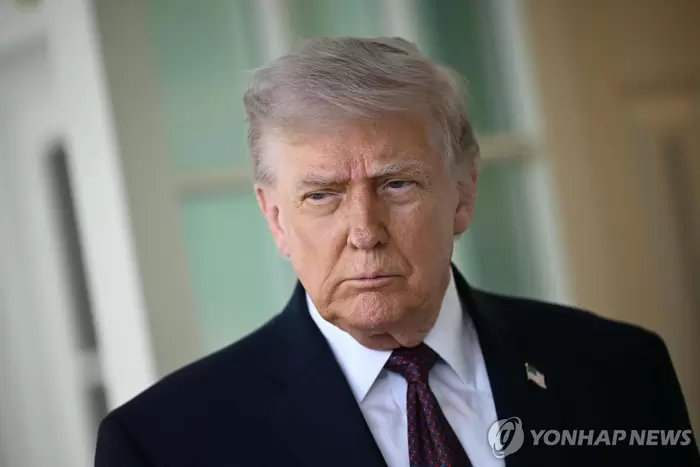
U.S. President Trump
U.S. President Donald Trump took a step back by declaring an open-ended ceasefire, but the power struggle over control of the Strait of Hormuz is heating up.
In response to President Trump's insistence on maintaining a naval blockade against Iran, Iran retaliated with a de facto show of force by seizing ships in the Strait of Hormuz, further escalating tensions.
With President Trump blaming internal disagreements within Iran and Iran blaming President Trump's naval blockade for the negotiation deadlock, an unstable situation where a diplomatic exit is hard to find is likely to continue for some time.
President Trump made little mention of the Iran war until the afternoon of the 22nd (local time), the day after declaring the ceasefire extension.
While he claimed on social media platform Truth Social that eight Iranian female protesters were spared execution thanks to his request, he mostly posted about U.S. domestic political issues, refraining from mentioning the Iran war.
He also largely refrained from giving fragmented information through various media outlets and brief interviews that day.
Confusion persists. U.S. media reported that President Trump extended the ceasefire with a 3-5 day period in mind, even though he didn't mention an expiration date, but White House spokesperson Caroline Leavitt denied the report in a Fox News interview, stating that no deadline had been set.
While President Trump's declaration of a ceasefire extension has temporarily averted a full-scale resumption of attacks on Iran, tensions over control of the Strait of Hormuz are tighter than ever.
Feeling the burden of resuming attacks, President Trump appears to have chosen to maintain the naval blockade against Iran as a way to pressure Iran to come to the negotiating table as soon as possible.
Under pressure from rising oil prices, President Trump desperately needs an exit strategy. CNN reported that President Trump's staff privately advised him that if he eased pressure without a set ceasefire expiration date, there was a risk that Iran would drag out negotiations.
Iran criticized President Trump's adherence to the naval blockade, firing upon three merchant ships and seizing two in the Strait of Hormuz.
It was a kind of show of force against President Trump, who stated he would extend the ceasefire but could not lift the naval blockade.
Mohammad Baqer Ghalibaf, the Speaker of Parliament and head of Iran's peace negotiation delegation, criticized that due to the U.S. naval blockade, the ceasefire has become meaningless and the reopening of the Strait of Hormuz has become impossible. This was a pressure tactic to lift the naval blockade.
Following this, Iranian President Masoud Pezeshkian criticized that "Iran has always welcomed dialogue and agreement and will continue to do so," but that the U.S. naval blockade and threats are obstructing negotiations.
Iran, emphasizing its willingness to negotiate, effectively blamed President Trump for the deadlock.
Strait of Hormuz
With President Trump declaring a ceasefire extension and setting the expiration date as 'until Iran resolves internal disagreements, presents a unified proposal, and negotiations conclude,' it seems unlikely that a breakthrough for the resumption of negotiations between the U.S. and Iran will be achieved soon.
There is also a possibility that military actions in the Strait of Hormuz, such as ship seizures, could accidentally trigger a conflict.
However, both the U.S. and Iran find escalation burdensome, so it is expected that for now, they will continue exploratory talks, mediating through Pakistan, while trying to control the level of tension as much as possible.
Another variable is that with the Iran war not ending for nearly 8 weeks, the '60-day' limit for the U.S. President to wage war without congressional approval will expire on May 1st, about a week later.
This is according to the War Powers Act enacted in 1973. This law was created to limit the president's ability to deploy U.S. forces into long-term conflicts without congressional approval, requiring withdrawal within 60 days if intervention occurs without such approval.
However, if the president can demonstrate 'unavoidable military necessity,' an additional period of up to 30 days is allowed.
Military operations against Iran began on February 28, but since President Trump notified Congress on March 2, the 60-day period ends on May 1.
The opposition Democratic Party had tried to stop the Iran war by applying the War Powers Act, but was blocked by the ruling party's opposition.
However, it is uncertain whether the Republican Party will shield President Trump after May 1. Voices within the Republican Party are already emerging, indicating they will not approve a 30-day extension, fearing the impact on the midterm elections.
There is also a high possibility that President Trump will disregard the 60-day limit. The New York Times (NYT) reported that there is a precedent from 2011 when then-President Barack Obama continued military intervention in Libya beyond the 60-day limit.
Iranian Chief Negotiator Speaker Ghalibaf
Newsletter
Get key news delivered to your email every morning
to leave a comment.