
to leave a comment.
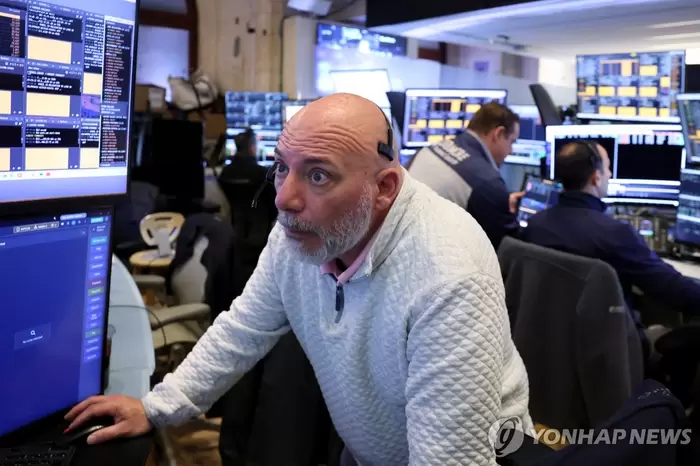
A trader at the New York Stock Exchange (NYSE), USA
As tensions in the Middle East escalated again, freezing global financial markets, the virtual asset market also could not avoid geopolitical risks and showed an overall decline. However, a rebound, partially recovering losses, is being observed as positive earnings reports from tech stocks in the US market were announced late at night.
According to CoinMarketCap, a cryptocurrency market tracking site, as of 6:29 AM on the 24th, the global virtual asset market capitalization recorded $2.6 trillion, a 0.86% decrease from the previous day. Bitcoin (BTC), the leading cryptocurrency, is trading at $77,913.35, down 0.87% from 24 hours ago. Ethereum (ETH), the leading altcoin, fell 3.06% to $2,324.70, and Solana (SOL) dropped 1.93% to $85.72, indicating strong overall downward pressure. XRP (Ripple) also remains at $1.43, down 0.52%. The Fear & Greed Index, which indicates overall market sentiment, is at 59, pointing to a 'neutral' phase.
This 24-hour chart decline is the result of macro risk-aversion sentiment gripping the market due to the failure of further armistice negotiations between the US and Iran. Geopolitical fear reached its peak with news that US President Donald Trump ordered a strengthening of the naval blockade of the Strait of Hormuz, additional US Navy aircraft carriers were deployed, and Iran's air defense system in Tehran was reactivated. As a result, international oil prices surged, and the three major indices of the New York stock market all closed lower, leading to a strong correlation and sell-off in the virtual asset market, which is classified as a risky asset.
However, the 1-hour chart shows signs of a mood reversal. Major virtual assets are showing slight rebounds, turning red indicators green, with Bitcoin up 0.20%, Ethereum up 0.24%, and Dogecoin up 0.39% compared to an hour ago.
This short-term rebound is attributed to Intel's optimistic earnings outlook, announced after the close of the New York stock market's regular session, which revived investor sentiment across tech stocks and risky assets. Investor sentiment, which had plunged due to negative headlines, quickly regained rationality and began to consolidate a base, relying on corporate fundamentals and buy-the-dip strategies, much like Wall Street experts' diagnosis that "the half-life of market shocks caused by recent headline issues is significantly shortening."
Experts predict that the virtual asset market will continue to fluctuate in a sideways trend for some time, driven by news flow from the Middle East. While downward volatility could increase if additional geopolitical negative factors, such as an escalation of conflict, emerge, the dominant analysis is that the market's speed in absorbing external shocks is accelerating, as seen in this 1-hour chart rebound. Ultimately, attention will return to intrinsic indicators such as macroeconomic fundamentals and the trend of spot fund inflows.
*Disclaimer: This article is for investment reference only, and we are not responsible for any investment losses based on it. The content should be interpreted for informational purposes only.*
Newsletter
Get key news delivered to your email every morning
to leave a comment.