
to leave a comment.
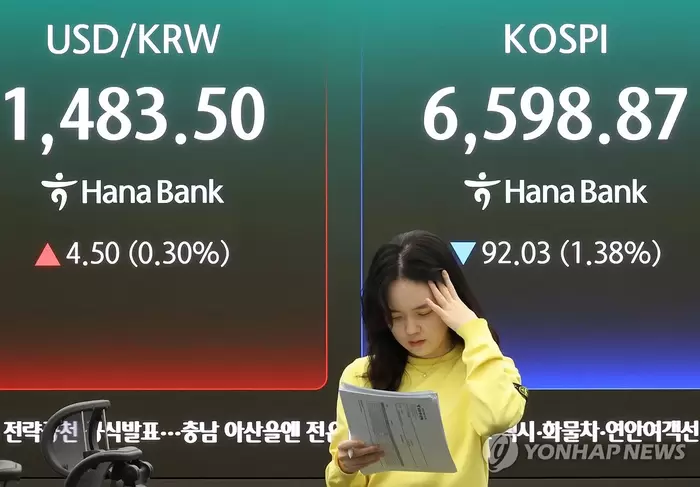
Kospi down 1.38%
Although the Kospi is nearing the 7,000 mark, the volatility index is rebounding, and individual investors are betting on a decline.
According to the Korea Exchange and Yonhap Infomax on the 1st, on the 30th of last month, the Kospi closed at 6,598.87, down 1.38% from the previous trading day.
The index had been on a three-day consecutive high streak based on closing prices and took a breather today, but is only about 400 points away from the 7,000 mark.
However, at the same time, the Kospi 200 Volatility Index (VKOSPI), dubbed the 'Korean fear index', is also rebounding.
The VKOSPI, which soared to 80.37 on March 4th when the war between the US/Israel and Iran escalated, fell to 48.51 on April 17th as Middle East risks somewhat eased.
Since then, it began to rebound, rising to 55.57 on April 29th, and maintained a relatively high level of 54.34 the next day.
It is interpreted that the burden from the Kospi's significant short-term rise in April, which not only recovered all losses from the war but also surpassed the 6,700 mark for the first time ever, led to the rise in VKOSPI.
Consequently, individual investors flocked to products that bet on a Kospi decline.
The exchange-traded fund (ETF) most invested in by individuals last month was 'KODEX 200 Futures Inverse 2X', with a net purchase of 645.4 billion won.
This contrasts with foreign investors and institutions, whose most net-purchased ETFs during the same period were 'TIGER MSCI Korea TR' (667.6 billion won) and 'KODEX Leverage' (1.2443 trillion won), respectively.
However, as the Kospi rose by 30.61% last month, the return rate of 'KODEX 200 Futures Inverse 2X' recorded -47.35%.
The securities industry projected that the Kospi's upward potential would remain valid in May.
Noh Dong-gil, a researcher at Shinhan Investment Corp., stated, "The essence of April's rebound was a market where upward earnings overcame discount rate burdens," adding, "During the March correction, the Kospi fell by 12.9%, but the 12-month forward EPS (earnings per share) increased by 8.7%, and the P/E (price-to-earnings ratio) decreased by 19.9%."
He said that for this month, "the key is how much earnings can absorb the discount gap created by exchange rates and oil prices," and suggested a Kospi fluctuation range of 6,200 to 7,500.
Byun Jun-ho, a researcher at IBK Investment & Securities, said, "While there is a historical tendency for the stock market to be relatively weak in May, there has never been a case where the Kospi fell in May in years when it surged by more than 5% in April," adding that "this year's earnings expectations, especially centered around semiconductors, are expected to continue beyond the second quarter."
He stated, "While it is necessary to keep open the possibility of a short-term correction due to technical burdens, there is no great need to worry about the negative effects of 'Sell in May' this year," adding, "Instead, a strategy of buying on dips during a technical pullback in early to mid-May could be more effective."
Newsletter
Get key news delivered to your email every morning
to leave a comment.