
to leave a comment.
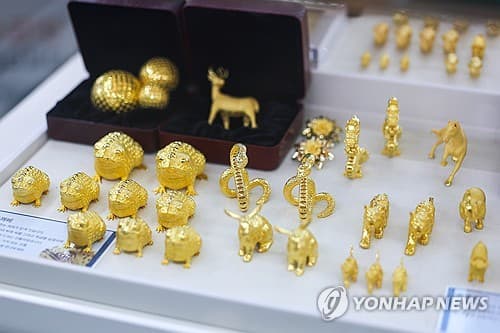
"In a state of war stalemate, the direction of gold will likely be determined by US monetary policy."
Gold, which was considered a representative safe-haven asset, recorded an all-time high early this year but then plummeted after being directly hit by changes in the international situation, drawing attention to its future movements.
According to the Korea Exchange on the 3rd, the domestic gold price in the KRX gold market on the 30th of last month was 217,240 won per gram, the lowest level this month. This is a 20% drop compared to the all-time high (closing price of 269,810 won) updated on January 29.
Even on the 2nd of last month, when the domestic financial market was shocked by the outbreak of the Iran war, gold prices seemed to briefly rise to the 223,000 won range, but then continuously fell, showing a different movement from that of a typical safe-haven asset.
The trend of international gold futures prices is similar. According to Yonhap Infomax, a financial information service provider, the price of June delivery gold futures traded on COMEX, a metals futures exchange under the Chicago Mercantile Exchange Group (CME), closed at $4,629.6 per ounce (approximately 28.34g, about 6.83 million won in Korean currency) as of the 30th of last month, remaining at its lowest point this month.
This downward trend means that the market did not simply respond to the increased uncertainty caused by the outbreak of war by investing in safe-haven assets. The prospect that rising oil prices due to the blockade of the Strait of Hormuz would act as inflationary pressure, preventing the US from easing monetary policy through interest rate cuts, limited gold investment sentiment.
If interest rates on the dollar remain above a certain level, the attractiveness of investing in gold, which does not accrue interest, typically decreases.
For this reason, experts believe that in a situation where the opening of the Strait of Hormuz is sluggish, the actions of Kevin Warsh, whose debut as the next chairman of the US Federal Reserve (Fed) is imminent, will be a key factor in the direction of gold prices.
Warsh has been classified as a 'hawk' who prefers monetary policy tightening, but he has also shown some support for the argument that interest rates should be cut, in line with the demands of US President Donald Trump, who nominated him as chairman, leading to divided market forecasts.
Hwang Byung-jin, head of FICC Research at NH Investment & Securities, analyzed, "If tightening occurs while the Strait of Hormuz is not reopened, demand could be destroyed and the economy could fall into recession, so I believe that Kevin Warsh, the next chairman candidate, will not (tighten)."
He added, "However, if prolonged high oil prices are added to this, interest in stagflation (inflation amid economic recession) will increase, and gold prices, a key hedge asset, are expected to gain upward momentum."
Choi Jin-young, a researcher at Daishin Securities [003540], said, "Even if interest rates are cut under the Warsh regime, if quantitative tightening (QT - balance sheet reduction) is implemented, assets that reflect liquidity in advance, like gold, will have limitations even if they rise."
He further predicted, "Even if gold prices rebound due to the end of the war this month, it will be difficult to surpass the previous high."
Newsletter
Get key news delivered to your email every morning
to leave a comment.