
to leave a comment.
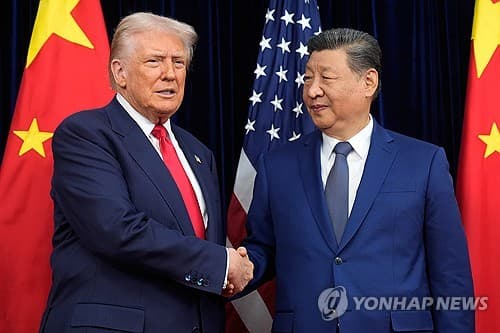
Trump arrives in Beijing last night, begins 2-night, 3-day state visit
Summit after welcome ceremony at Great Hall of the People... Visit to Temple of Heaven, state dinner
Also predicted to be a gauge for transition from US-centric 'unipolar' international order to a dual-power system
US President Donald Trump and Chinese President Xi Jinping will hold a summit in Beijing, China, on the morning of the 14th (local time).
President Trump arrived in Beijing last night and began his 2-night, 3-day state visit.
The two leaders are scheduled to hold an official welcome ceremony at the Great Hall of the People in Beijing around 10 AM today, followed immediately by a summit.
After the summit, they will visit the Temple of Heaven (天壇, the altar where emperors offered sacrifices to heaven) in Beijing together, and in the evening, they will have a state dinner.
This direct meeting between President Trump and President Xi is the first in about six months since they met in Busan on the occasion of the Asia-Pacific Economic Cooperation (APEC) summit in October last year.
Their meeting in Beijing is the first in nine years since 2017, during President Trump's first term.
At today's summit, which is drawing global attention, key bilateral and international issues such as tariffs and trade disputes, the situation in Iran, the Taiwan issue, and high-tech controls are expected to be extensively discussed.
The two countries, which had been in conflict over high tariffs and export controls, are now in a 'truce' and both agree on the need for stable relations amidst growing global economic uncertainty, so it remains to be seen whether they can find some common ground.
President Trump needs tangible results such as soybean, beef, and Boeing aircraft exports ahead of the November midterm elections, and President Xi is also expected to focus on creating a favorable negotiating environment in the strategic competition with the United States.
The Middle East issue is highly likely to be one of the core agendas of this summit.
With ongoing tensions between the US and Iran, the Iranian nuclear issue and the tense situation in the Strait of Hormuz are expected to be discussed intensively.
President Trump is expected to ask President Xi for an active mediating role regarding the Iran issue, and China is also emphasizing its role as a mediator in Middle Eastern affairs, so attention is focused on what message the two sides will deliver.
On the other hand, the Taiwan issue is one of the areas where the two countries' differences are most sharply revealed.
The United States is expanding arms sales and security cooperation with Taiwan, while China strongly opposes this, defining it as an 'infringement of core interests'.
Before his visit to China, President Trump mentioned that he would discuss the issue of US arms sales to Taiwan in his meeting with President Xi, but China reaffirmed its opposition to this.
Along with this, global issues such as artificial intelligence (AI) safety, high-tech norms, and climate change response are also of interest as to whether they will be on the discussion table.
President Trump also plans to raise the issue of the imprisonment of Hong Kong anti-China journalist Jimmy Lai, but China is objecting, calling it an internal affair.
On the last day of President Trump's visit to China, the 15th, the two leaders are scheduled to continue further discussions with small tea talks and luncheon meetings.
Afterward, President Trump will conclude his 2-night, 3-day visit to China and return home.
Among Chinese experts, there is also an assessment that this summit could be a watershed moment for gauging the possibility of a transition from the existing US-centric 'unipolar' international order to a US-China dual-power system.
If President Trump moves to expand strategic cooperation with China, China's influence in the Asian region will grow further, and the diplomatic calculations of regional countries such as South Korea may become even more complex, according to predictions.
Zheng Yongnian, Dean of the School of Public Policy at the Chinese University of Hong Kong, Shenzhen Campus, said in a recent interview, "(US-China relations) have reached a very important point," adding, "There is also a view in the United States that compares President Trump's visit to China to that of former US President Richard Nixon, which brought about a US-China détente."
Newsletter
Get key news delivered to your email every morning
to leave a comment.