
to leave a comment.
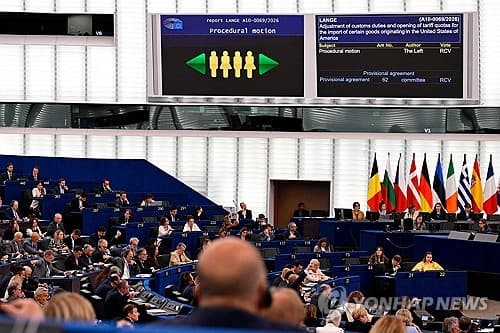
Conflicts remain over Digital Markets Act, etc... EU's stance firm despite US claims of "hindering market access"
The European Union (EU) finally approved on the 25th (local time), after several months of delay, the legislation related to the abolition of tariffs on US goods, as requested by the Donald Trump administration.
With President Trump having set July 4th as the deadline, the bill barely passed, avoiding a situation where trade conflicts between the two sides would escalate to their worst. However, concerns are also rising that new conflicts over non-tariff trade barriers will begin.
According to Reuters and the Wall Street Journal (WSJ) on this day, the governments of the 27 EU member states proceeded with the adoption of the trade agreement bill agreed upon by the EU and the US in July last year.
Previously, the European Parliament had voted on the approval of the trade agreement with the US in Strasbourg, France, on the 16th, passing it with 440 votes in favor, 151 against, and 50 abstentions.
Once the agreement comes into effect, the EU will abolish tariffs on US manufactured goods and some agricultural products, and the US will limit the tariff ceiling on EU products to 15%.
The WSJ stated, "This was the last official vote in a multi-stage process," but predicted, "The EU will now have to deal with US complaints that its regulations block US companies from entering the EU market."
The US complaints mentioned by the WSJ refer to EU non-tariff trade barriers such as the Digital Markets Act, Digital Services Act, deforestation regulations, methane emission schemes, and carbon border tax.
The EU's big tech regulations based on the Digital Markets Act are a major target of criticism from the Trump administration. The Trump administration claims that the EU uses the Digital Markets Act to impose massive fines on US companies and force them to change their operating methods, thereby discriminating against them.
The Digital Services Act holds social media (SNS) and search platforms responsible for issues such as the spread of illegal content and the use of false information, demanding that they resolve these problems. The US views such EU demands as an infringement on freedom of expression.
Regarding deforestation regulations, the EU emphasizes that imported timber and rubber products should not harm global forests, and methane regulations require importers to meet methane emission standards.
Andrew Puzder, the US Ambassador to the EU, pointed out that these issues are major concerns for the US, while EU tariff reductions are relatively easier to handle.
He added, "The really difficult part is non-tariff trade barriers," and "If these were easy, they would have been solved a long time ago."
The WSJ reported that while the Trump administration is demanding amendments to related laws or exception clauses, the EU's stance remains firm.
A spokesperson for the EU Commission stated, "The EU has firmly and consistently explained that its legislative framework and regulatory autonomy are not subject to negotiation."
Newsletter
Get key news delivered to your email every morning
to leave a comment.