
to leave a comment.
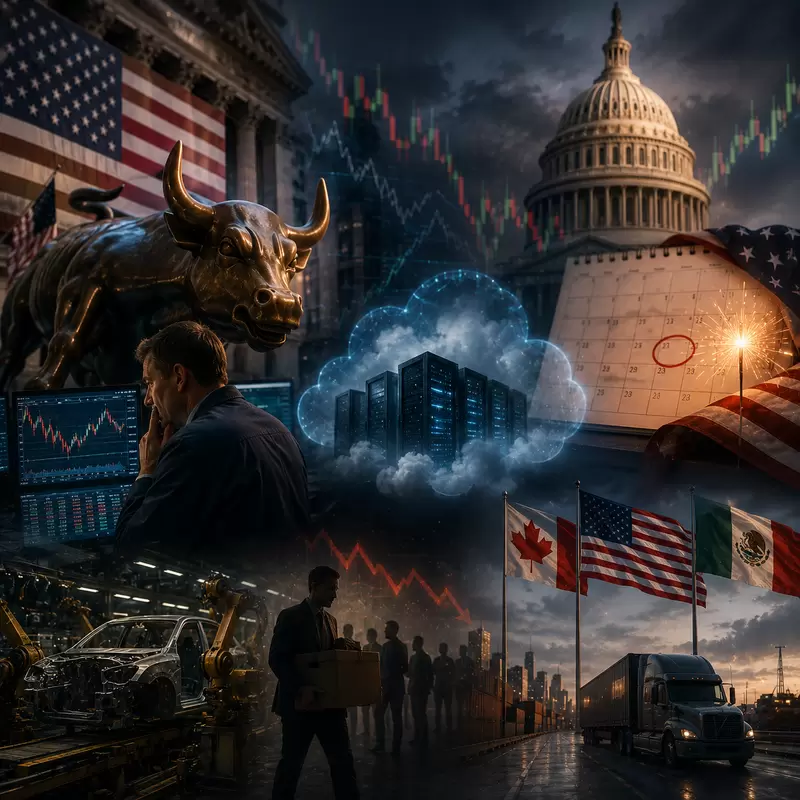
▲ US stock market, Artificial Intelligence (AI), US Congress/AI-generated image
The U.S. stock market faced a barrage of challenges at the final hurdle of a short trading week before the Independence Day holiday: an employment report, AI investment fatigue, and uncertainty surrounding the North American trade agreement. Index futures struggled to find a clear direction, and investors are simultaneously monitoring signs of a slowing labor market and the spread of tech stock adjustments.
According to the economic media outlet CNBC on July 2 (local time), U.S. stock futures moved without a clear direction before the opening. The S&P 500 index closed lower the previous day, and the market entered its last trading day before the observed Independence Day holiday on July 3. The early market sentiment on this day was considered a key variable to be influenced by the release of the June employment report and the weakness in tech stocks.
Investors' primary concern is the U.S. labor market. The market expected non-farm payrolls to increase by 115,000 in June and the unemployment rate to remain at 4.3%. If employment is weaker than expected, concerns about an economic slowdown could grow, but at the same time, expectations surrounding the Federal Reserve's interest rate path could also be shaken. As employment indicators are released during a short trading week, both bond yields and stock market volatility could increase simultaneously.
AI-related stocks are once again being tested. Meta (META) is reportedly pursuing entry into the cloud business, selling its excess AI computing power to external customers. Wall Street views this as a strategy to recoup AI infrastructure investments, but it also believes that debates over overcapacity and margin pressure for mega-tech companies could intensify. With semiconductor and AI hardware stocks already faltering, Meta's move has reignited overall valuation concerns for tech stocks.
Trade policy also fueled market uncertainty. U.S. President Donald Trump decided not to extend the United States-Mexico-Canada Agreement (USMCA), which he previously signed, in its current form for the long term. While the agreement will not terminate immediately, it will enter an annual review process, leaving open the possibility of expiration after 10 years. North American automotive, agricultural, and manufacturing supply chains are once again exposed to negotiation risks, putting companies in an environment where it is difficult to plan investments.
The backlash from AI-driven layoffs also came to light. Ford Motor (F) reportedly redeployed about 350 veteran engineers to address quality issues that automation systems could not solve. Commonwealth Bank of Australia also reversed its decision to cut 45 customer service jobs after customer inquiries increased following the introduction of an AI voice bot. Data cited by CNBC showed that 32% of U.S. recruiters who eliminated positions due to AI later rehired for the same or similar roles. The market is now beginning to question whether AI is a panacea for cost reduction or, conversely, a backlash that increases corporate costs.
[Article Key Summary]
-The U.S. stock market simultaneously monitored the June employment report and tech stock weakness ahead of the observed Independence Day holiday.
-Meta's pursuit of an AI cloud business and the weakness in semiconductor stocks reignited the debate over AI investment overheating.
-The U.S.'s refusal to extend USMCA long-term and Ford's re-deployment of engineers sounded a warning for both trade and AI cost-saving strategies.
*Disclaimer: This article is for investment reference only, and we are not responsible for any investment losses based on it. The content should be interpreted for informational purposes only.*
Newsletter
Get key news delivered to your email every morning
to leave a comment.