
to leave a comment.
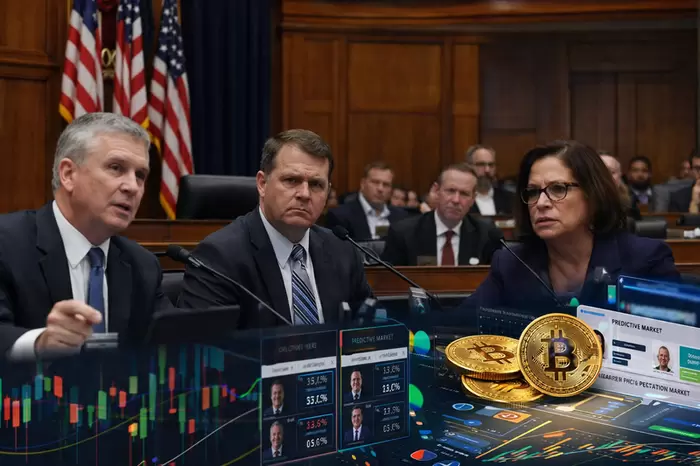
▲ U.S. Congressional Hearing, Bipartisan Regulatory Pressure on Prediction Markets and Cryptocurrencies/ChatGPT Generated Image
The U.S. Congress has taken a step back from its previously favorable stance, beginning to put the brakes on both cryptocurrency and prediction market regulations simultaneously.
According to DL News on April 17 (local time), Mike Selig, Chairman of the U.S. Commodity Futures Trading Commission (CFTC), appeared before a House hearing and faced bipartisan pressure regarding the direction of regulation for prediction markets and cryptocurrencies. Notably, even Republican members of Congress openly mentioned the need for regulation, indicating a crack in the existing one-sided pro-crypto stance.
Republicans specifically pointed out the issue of regulatory gaps. Representative Austin Scott of Georgia mentioned Hyperliquid's crude oil market, criticizing, “This product is virtually identical to those on the U.S. Chicago Mercantile Exchange (CME) or Intercontinental Exchange (ICE), but it lacks fund segregation, market surveillance, and U.S. oversight.” In response, Selig stated that a plan to bring such markets into the U.S. regulatory framework is necessary and expressed willingness to support legislation.
Another Republican Congressman, Don Bacon, raised suspicions of insider trading in prediction markets. He cited betting cases related to regime change in Venezuela or the Iran war, noting, “There are instances where a single statement moves the market and even journalists are threatened.” Consequently, the need for additional authority to regulate prediction markets was formally brought to the discussion table.
Democrats launched a more aggressive offensive. They simultaneously raised issues regarding the risks of unregulated financial products, along with staff shortages and political conflicts of interest. In particular, they highlighted the potential for manipulation, pointing out that some prediction market products are structured to allow betting on whether certain statements will be made. In response, Selig stated that relevant regulations are being revised and various opinions are being gathered.
Political debates also intensified. Democrats questioned the impartiality of regulatory authorities, citing that Donald Trump's eldest son served as an advisor to Kalshi and Polymarket. Selig strongly refuted this, stating that “regulations are enforced without political considerations,” and even used the term “insulting” regarding the allegations, showing his discomfort.
This hearing is interpreted as a signal that the U.S. political establishment's view on cryptocurrencies and prediction markets is changing. The previous trend of deregulation, primarily maintained by Republicans, is weakening, and the need for regulation is beginning to be discussed on a bipartisan basis, suggesting an inevitable shift in the pace of future legislative efforts.
*Disclaimer: This article is for investment reference only, and we are not responsible for any investment losses based on it. The content should be interpreted for informational purposes only.*
Newsletter
Get key news delivered to your email every morning
to leave a comment.