
to leave a comment.
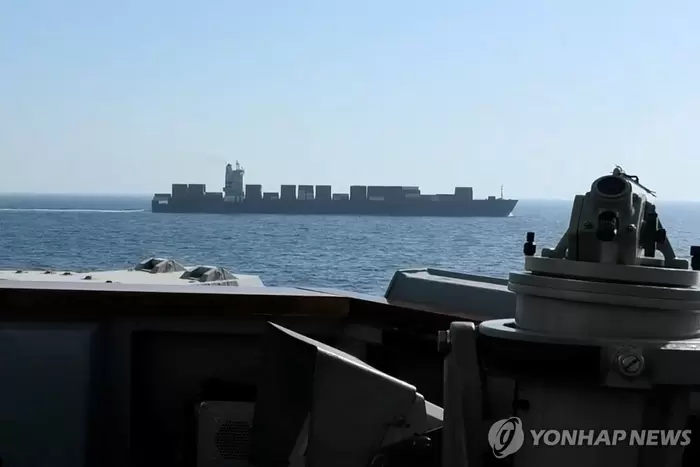
Iranian cargo ship Tuskaho seized by US forces
The United States and Iran stand at a crossroads between compromise and the resumption of war, with only one day left until the truce deadline expires.
Tensions are escalating as the US military has seized an Iranian cargo ship, and Iran has immediately warned of retaliation, amidst uncertainty even about whether a second round of talks for a ceasefire agreement will be held.
The US Central Command announced that on the 19th (local time), they fired upon and seized the cargo ship Tuskaho, which was en route from China to Bandar Abbas, Iran.
The United States is implementing a naval blockade to prevent ships traveling to and from Iran in response to Iran's blockade of the Strait of Hormuz.
This is reportedly the first known instance of US forces directly using force in this process.
Iran immediately protested.
Hatam Al-Anbiya, spokesperson for the Central Military Headquarters, which integrally commands the Iranian military, characterized this act as a violation of the truce.
He told the semi-official Tasnim news agency, affiliated with the Iranian Revolutionary Guard Corps, "We warn that we will soon respond and retaliate against this armed act of piracy by the US military."
Iran also claimed to have carried out a drone (UAV) attack on US warships in response to the seizure of its cargo ship.
Due to this escalation of tensions, the possibility of progress in the ceasefire negotiations announced by the US government has once again become uncertain.
The deadline for the two-week truce agreed upon by the United States and Iran on the 7th is approaching, with only one day left until the 21st. The Associated Press and CNN reported that the truce ends on the 22nd.
US President Donald Trump had previously stated that if a ceasefire agreement with Iran was not reached by the 22nd, he would not extend the truce and would resume airstrikes.
President Trump also reiterated his threat to bomb all power plants and bridges in Iran if Iran did not accept the agreement.
US President Donald Trump
While concerns about a full-scale war re-erupting are being raised, it is currently unclear whether a second round of ceasefire negotiations can even be achieved.
Mediating countries like Pakistan hope that negotiations will resume in Islamabad on the 20th, but Iran maintains that there will be no talks as long as the US naval blockade continues.
According to Iran's state news agency IRNA, Iranian President Masoud Pezeshkian said in a phone call with Pakistani Prime Minister Shehbaz Sharif that the US naval blockade "raises doubts about sincerity" and "made it clearer than ever that the US is trying to betray diplomacy by following in the footsteps of the past."
An Iranian source told Al Jazeera, "We believe the enemy is using deception and is about to start a new phase of escalation."
The US and Iran still show differences in their positions on key ceasefire negotiation issues, such as nuclear material regulations including uranium enrichment and the export of highly enriched uranium, and control of the Strait of Hormuz.
There are also observations that it is difficult to coordinate negotiation goals due to the conflict within Iran between hardliners, centered around the Islamic Revolutionary Guard Corps, and moderates, centered around politicians who take a pragmatic stance.
Previously, Iran had reopened the Strait of Hormuz on the 17th in line with the ceasefire agreement between Israel and Lebanon, but then re-blocked the strait just one day later, citing the continued US naval blockade against Iran.
Israel, which explicitly desires the continuation of the war and is acting as another variable in the ceasefire, is also reportedly preparing to resume attacks.
The Israeli military is setting new military targets in preparation for a possible breakdown of the truce with Iran, reported the Israeli daily Maariv.
Although the overall situation is uncertain, optimism is also emerging within the US government that a dramatic agreement can be reached.
President Trump said in an interview with Axios today, "I feel good. The basic framework of an agreement has been established. I think there is a very high possibility of completing (the negotiation)."
As military tensions escalated while the US-Iran ceasefire negotiations remained stalled, international oil prices surged again.
According to Bloomberg, Brent crude futures for June delivery were trading at $95.93 per barrel as of 8:30 AM KST on the 20th, up 6.14% from the previous close.
US West Texas Intermediate (WTI) crude futures for May delivery jumped 7.35% from the previous close to $90.01 per barrel.
Newsletter
Get key news delivered to your email every morning
to leave a comment.