
to leave a comment.
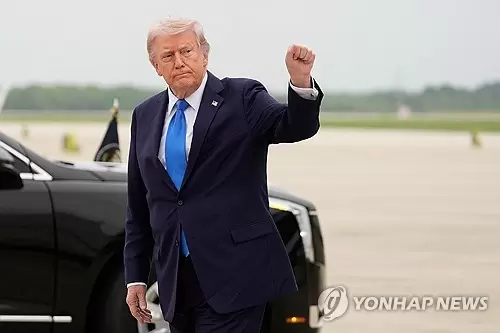
President Trump
The future of the second round of peace negotiations between the US and Iran, currently in a truce, has become uncertain again, revealing that a significant gap still exists between the two sides.
US President Donald Trump announced on the 25th (local time) that he had canceled the visit to Pakistan by the US negotiating team, which included Middle East envoy Steve Witkoff and his eldest son-in-law Jared Kushner.
This announcement came after it was confirmed that Iranian Foreign Minister Abbas Araghchi, who was staying in Islamabad, the capital of mediating nation Pakistan, had left Pakistan on that day.
Previously, the White House had announced the previous day that the US negotiating team would depart for Pakistan that morning for face-to-face talks with Iran. This had temporarily raised hopes for a resumption of negotiations, but for now, a second round of face-to-face talks appears virtually impossible this weekend.
Following the breakdown of the first round of peace talks held in Pakistan on the 11th-12th, and the failure of the second round of negotiations expected on the 21st, the cancellation of this weekend's talks has once again made the resumption of dialogue uncertain.
Iran has maintained from the outset that it had no plans to hold direct talks with the United States in Pakistan.
Indeed, Minister Araghchi, who arrived in Pakistan the day before, met with Pakistani officials, including Prime Minister Shehbaz Sharif, to convey Iran's position on peace, and then headed to Oman on that day.
This has put the White House, which had publicly announced the possibility of face-to-face talks, in a somewhat awkward position.
A US official, who requested anonymity, told the Washington Post (WP) that contrary to Iran's official stance of 'no direct talks,' they had received confirmation from the Iranian side that they would attend face-to-face talks, and if not, the US negotiating team's trip to Pakistan would not have been scheduled.
President Trump also said in a media interview that day, "We won't fly for 18 hours just to exchange talks about nothing."
This is interpreted to mean that the negotiating team will not be sent to Pakistan if no substantial progress in negotiations is expected.
Pakistan Prime Minister Shehbaz Sharif and Iranian Foreign Minister Abbas Araghchi
Minister Araghchi shared on social media the results of his visit to Pakistan, stating, "We shared Iran's position on a viable framework for peace," and added, "We still need to see if the US is truly serious about diplomacy," implying that the atmosphere for dialogue is not yet fully ripe.
This war of nerves shows that both sides still have significant differences on key issues.
Key issues where both sides are in a tense standoff include the Strait of Hormuz and Iran's nuclear program.
The United States is escalating its naval blockade to increase pressure on Iran, further heightening tensions in the Strait of Hormuz, a global oil shipping lane.
Despite US pressure, Iran is showing its determination to continue blockading the Strait of Hormuz. The Iranian Islamic Revolutionary Guard Corps stated in a statement that day, "Controlling the Strait of Hormuz and keeping the United States and its White House supporters in the shadow of its deterrent effect is Iran's decisive strategy."
On the nuclear issue, the US is demanding limitations on Iran's uranium enrichment and the removal of its stockpiles, while Iran is reportedly taking a cautious stance on this.
It is assessed that such disagreements will not be easily resolved in the short term.
The WP reported that Iran's peace-related proposals include Russia providing guarantees to deter further US attacks on Iran, and a plan for Iran and Oman to jointly control the Strait of Hormuz.
However, President Trump is increasing pressure on Iran while also leaving room for dialogue, drawing attention to the possibility of resuming negotiations in the future.
President Trump said that day, "We have all the cards, and they have no cards," adding, "If they want to talk, all they have to do is call."
This is interpreted as emphasizing the US's superior negotiating power through military operations and naval blockades, while also indicating that the possibility of negotiations is not closed.
Furthermore, President Trump also indicated that progress was being made behind the scenes by stating that he had received an improved proposal from Iran immediately after canceling the US negotiating team's visit to Pakistan.
Accordingly, it is suggested that the US and Iran may continue indirect negotiations through Pakistan for the time being to seek common ground.
In particular, with reports from Iranian state media that Minister Araghchi plans to visit Pakistan again after his schedule in Oman and before heading to Russia, there are speculations that discussions for face-to-face negotiations could pick up pace again.
Newsletter
Get key news delivered to your email every morning
to leave a comment.