
to leave a comment.
Citing 'non-compliance with trade agreement', "EU will be pressured to relocate factories more quickly"
Possibility of expanding scope of retaliation against EU following review of US troop reduction in Germany
Korea, competing with EU in US market, may have an advantage for now, but it's hard to be relieved
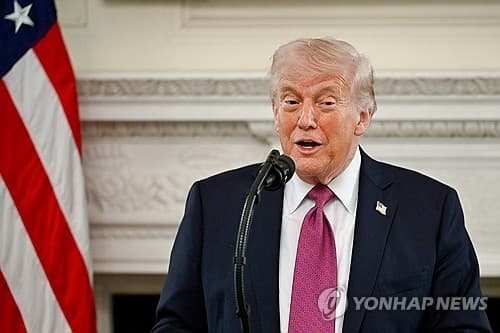
U.S. President Donald Trump announced on the 1st (local time) that tariffs on passenger cars and trucks from the European Union (EU) will be raised to 25% starting next week.
President Trump wrote on social media Truth Social that day, "Based on the fact that the EU is not complying with the trade agreement we fully agreed upon, I am pleased to announce that I will be raising tariffs on passenger cars and trucks from the EU entering the United States next week."
He then stated, "The tariff rate will rise to 25%."
President Trump also said, "It is fully understood and agreed that if they (EU) produce passenger cars and trucks in US factories, no tariffs will be imposed."
President Trump, who launched his second-term administration in January last year, imposed a 25% item-specific tariff on foreign-made automobiles starting April 3 last year. As a result, EU-made cars imported into the US were subject to a 27.5% tariff, including a basic tariff of 2.5%.
A day earlier, on April 2 last year, President Trump had announced the imposition of a 20% reciprocal tariff (differentiated tariff by economic entity) on the EU.
Consequently, both the US and the EU entered negotiations for a new trade agreement, and on July 27 last year, President Trump and EU Commission President Ursula von der Leyen met in Scotland, UK, to conclude trade negotiations, significantly lowering tariffs.
The agreement reached by both sides at the time was that the EU would purchase $750 billion worth of US energy and military equipment and additionally invest $600 billion in the US, while the US would lower reciprocal tariffs on the EU to 15% and uniformly reduce item-specific tariffs on automobiles, etc., to 15%.
Ultimately, President Trump's announcement today means restoring the item-specific tariffs on EU passenger cars and trucks to pre-trade agreement levels by increasing them by 10 percentage points from 15%.
President Trump's sudden announcement of tariff increases is primarily interpreted as being caused by 'non-compliance with the trade agreement', as he himself stated.
It means that the EU's slow pace in implementing investments in the US, which was a condition for tariff reduction, has repeatedly led to the tariff increase card being played. Previously, in January, he also threatened to raise tariffs on South Korea, citing delays in the passage of the Special Act on Investment in the US in the Korean National Assembly.
Meeting with reporters at the White House that day, President Trump, regarding the plan to raise tariffs on EU-made cars and trucks, cited 'non-compliance with the agreement' and said, "This applies to billions of dollars worth of imports coming into the United States, and this will force them to relocate their production facilities much more quickly."
He added, "Currently, car factories worth over $100 million are being built in the United States," and "All countries, including Japan, South Korea, Canada, and Mexico, are building factories in the US, but the EU is not complying with the agreement."
It is also interpreted that this is not unrelated to his complaints about the non-cooperation of major European allies during the war with Iran.
President Trump expressed significant disappointment, stating "I will remember this," regarding the refusal of key member states of the North Atlantic Treaty Organization (NATO), a military alliance between the US and Western European allies, to dispatch warships to the Strait of Hormuz and their non-allowance of US and Israeli aircraft to use some military bases in Europe, leading to strained relations between the US and NATO's European members.
Earlier, on the 29th of last month, President Trump also stated that he was considering reducing US troops stationed in Germany.
Following President Trump's announcement today, the EU is expected to be at a disadvantage in competition with Japanese and South Korean companies, which are still subject to a 15% tariff in the US automobile market for the time being.
However, some also observe that it is too early to be relieved about President Trump's 'indirect' retaliatory measures through tariffs, given that Japan and South Korea also did not actively respond to his calls for help.
Newsletter
Get key news delivered to your email every morning
to leave a comment.