
to leave a comment.
"Administration Confused Balance of Payments and Trade Balance"... Plaintiffs Win 2-1 Without Full Trial
Refusal to Apply Universal Ruling Beyond Plaintiffs... WSJ "Originally Temporary Application, Limited Immediate Impact"
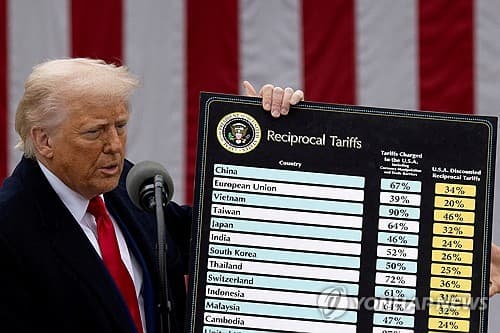
A first-instance court ruled that the 'global 10% tariffs' mobilized by U.S. President Donald Trump to replace the mutually imposed tariffs, which were deemed illegal, are also invalid.
Following the U.S. Supreme Court's ruling in February that reciprocal tariffs (country-specific tariffs) imposed under the International Emergency Economic Powers Act (IEEPA) were illegal, the Trump administration's 'Plan B' tariff policy is also being curbed by the judiciary.
On the 7th (local time), a three-judge panel of the U.S. Court of International Trade ruled 2-1 in favor of the plaintiffs, stating that the 10% global tariffs newly imposed by the Trump administration on all trading partners worldwide, based on Section 122 of the Trade Act, violated the law and were therefore invalid.
The court issued a permanent injunction, stating that the 10% global tariffs could not be applied to the importing companies that filed the lawsuit, and ordered the Trump administration to refund the tariffs already paid by the plaintiff companies, along with interest.
Previously, after the Supreme Court ruled in February that reciprocal tariffs based on IEEPA were illegal, President Trump had imposed a 10% global tariff on countries worldwide under Section 122 of the Trade Act.
Consequently, U.S. small and medium-sized businesses, including spice importer Burlap & Barrel and toy importer Basic Fun, filed a lawsuit with the U.S. Court of International Trade in March, arguing that the 10% global tariffs imposed by the Trump administration based on Section 122 of the Trade Act were illegal.
More than 20 states, including Oregon, also filed similar lawsuits against the Trump administration, but the court dismissed most of their claims, stating that the other states, excluding Washington, lacked standing as plaintiffs.
Section 122 of the Trade Act, which the Trump administration used as the basis for imposing the 10% global tariffs, grants the President the authority to impose tariffs for up to 150 days to address large and serious balance of payments deficits.
The majority of the judges on the panel determined that the Trump administration failed to meet the requirements of Section 122 of the Trade Act because it confused the balance of payments with the trade deficit when issuing the order for 10% global tariffs, despite these being fundamentally different concepts.
The balance of payments refers to an economic indicator that measures all forms of economic transactions between domestic residents and foreign entities, including goods, services, income, transfers, and finance.
In contrast, a trade deficit is a concept generally limited to goods transactions among these.
Some legal experts judged that the 10% tariffs based on Section 122 of the Trade Act were more clearly illegal than those based on IEEPA, leading to speculation that the Trump administration might have intended to use Section 122 to buy up to 150 days, while planning to restructure the tariff system using Section 301 of the Trade Act and Section 232 of the Trade Expansion Act, among others.
The court's decision today was made by the court accepting the plaintiffs' request and omitting a full hearing on the facts (summary judgment).
The court rejected the request to apply the injunction against the 10% global tariffs universally, beyond the plaintiff companies.
Meanwhile, dissenting Judge Timothy Stanceu disagreed with the majority's legal interpretation and found that the court's omission of a hearing on its own initiative was a procedural error, stating that all parties to the lawsuit should have been given a reasonable opportunity to respond.
The Wall Street Journal (WSJ) offered an analysis that the immediate impact of this ruling might be limited.
The newspaper stated, "The 10% tariffs under Section 122 of the Trade Act were set to expire in July, at which point the administration planned to transition to a different tariff system," adding, "Furthermore, because the court rejected a universal injunction, not all importers nationwide will receive immediate relief based on this ruling."
Newsletter
Get key news delivered to your email every morning
to leave a comment.