
to leave a comment.
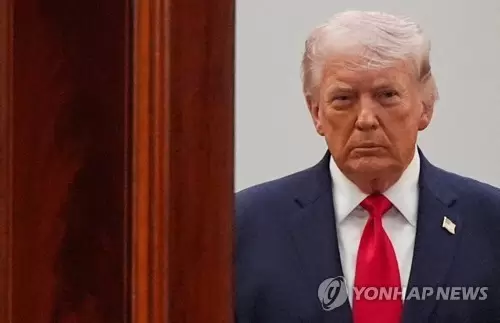
U.S. President Donald Trump
As the first peace talks between the United States and Iran in Pakistan broke down, attention is focused on the subsequent situation.
U.S. President Donald Trump now faces a choice: to continue to persuade Iran and keep negotiations going, or to re-engage in war to force Iran into submission.
However, Iran, believing it has secured a favorable position by blockading the Strait of Hormuz, is adhering to a peace proposal at the level of a victor nation.
Both continuing negotiations with Iran, assuming significant concessions, and resuming a war that is sure to deliver another major shock to the global market, pose a heavy burden on the United States, suggesting that President Trump's concerns are likely to deepen.
The U.S. delegation led by Vice President J.D. Vance and the Iranian delegation led by Parliament Speaker Hamad Baqer Ghalibaf met in Islamabad on the 11th (local time) for marathon peace talks, but after revealing differences over the top priority issues of normalizing passage through the Strait of Hormuz and Iran's nuclear program, they turned their backs on each other.
Vice President Vance said in a press conference immediately after the meeting, "We have put forward our best and final offer, and we will see if Iran accepts it." This implies that the ball is now in Iran's court.
However, Iran survived the overwhelming firepower offensive from the United States and Israel. Furthermore, it believes it holds an absolutely favorable position in the peace negotiations by blockading the Strait of Hormuz, and thus is unlikely to significantly back down on its demands.
Foreign media reports continued to state that Iran not only refused the immediate normalization of passage through the Strait of Hormuz but also rejected President Trump's suggestion of "joint collection of tolls" during these negotiations.
Furthermore, regarding the nuclear issue, which is the essential area of the negotiations, Iran is reported to have maintained a hardline stance, including not backing down on its demand for "maintaining the right to peaceful nuclear enrichment."
President Trump was watching a UFC fight in Miami when the US-Iran negotiations broke down.
During these talks, he indirectly participated in the dialogue with Iran by making several phone calls with Vice President Vance.
President Trump is expected to decide his next move after receiving a report from Vice President Vance, who is on his way back home. The opinions of his son-in-law Jared Kushner, who co-led the negotiating team, and Steve Witkoff, a decades-long friend and Middle East special envoy, are also expected to influence his decision.
Having confirmed Iran's stubborn stance, President Trump is at a crossroads: whether to continue dialogue with Iran and seek a compromise through mutual concessions, or to take military action to pressure Iran into making concessions.
The New York Times (NYT) pointed out, "This failure leaves the Trump administration facing several unwelcome options, all of which would entail considerable strategic and political costs."
The possibility remains that President Trump, who had even threatened to annihilate Iranian civilization, might opt for an all-out military confrontation.
The United States continues to pressure Iran by steadily increasing military assets, including ground troops, in the Middle East.
Specifically, following the Abraham Lincoln and Gerald R. Ford carrier strike groups previously deployed for the Iran war, the George H.W. Bush carrier strike group is heading to the Middle East.
Additionally, the U.S. is rapidly assembling thousands of Marines and elite airborne troops in the Middle East, preparing for operations to seize Kharg Island, Iran's key oil export base, and secure the Strait of Hormuz.
During negotiations with Iran, the U.S. military covertly sent two destroyers equipped with anti-aircraft missiles through the Strait of Hormuz into the Persian Gulf. This is a strategic move, a 'build-up' for the operation to retake the Strait of Hormuz, which will determine the fate of this war.
However, a military option, including ground warfare, is a heavy burden for President Trump as it could exacerbate the global energy supply emergency and inflict uncontrollable additional shock on the world economy, including that of the United States.
With rising inflation becoming evident in the U.S. ahead of this year's midterm elections, military operations that become more counterproductive the more they are pushed forward pose immense pressure on the Trump administration.
Oil price increase slows on the third day of the third price cap system
President Trump is also facing pressure from a 'war deadline.'
He initiated the Iran war without the approval of Congress, which constitutionally holds the power to declare war. The U.S. War Powers Act stipulates that if the President mobilizes troops in an emergency without Congressional approval, the operation must be terminated within 60 days.
While there is debate in the U.S. over the legal binding force of this regulation, if the war continues beyond this period, given the already low support for the Iran war within the U.S., the legal and political burden on the Trump administration is likely to increase significantly.
Conversely, if Iran does not back down on its 10 demands, which are nearly at the level of a victor nation, including the recognition of its control over the Strait of Hormuz, President Trump would face a significant burden in reaching an agreement with Iran through mutual concessions.
Iran is assessed to have gained a new and powerful card through this war: the blockade of the Strait of Hormuz, which can inflict significant damage on the global economy, including that of the United States.
Iran is strongly asserting its position to maintain 'strait control' even after the war, citing 'sovereignty,' and to institutionalize a 'toll' collection system.
The U.S. government officially advocates for a return to freedom of navigation, but President Trump has publicly discussed the idea of the U.S. and Iran "jointly collecting tolls," hinting at the possibility of accepting Iran's claims.
Acknowledging Iran's collection of tolls in the Strait of Hormuz would shake the very foundation of the global trade order, which is based on freedom of navigation in international waters.
An oil tanker passing through the Strait of Hormuz
Furthermore, the war unilaterally initiated by the U.S. has a strong character of shifting reconstruction costs to the international community. If the U.S. compromises with Iran on this issue in the future, it could face strong criticism from both within and outside the U.S., leading to significant repercussions.
Moreover, regarding the core issue of Iran's nuclear program, President Trump must achieve a better outcome than the 2015 Iran nuclear deal (Joint Comprehensive Plan of Action, JCPOA), which he abandoned, to justify this war.
However, Iran is observed to likely use its ability to blockade the Strait of Hormuz as a negotiating leverage, and after declaring no intention to develop nuclear weapons, it might seek to preserve its potential nuclear development capabilities, such as maintaining the right to uranium enrichment.
President Trump has not yet directly reacted to the breakdown of these negotiations.
However, in the early hours of the 12th, he shared a report from a right-wing alternative media outlet on Truth Social, implying that if Iran refuses negotiations, President Trump would initiate a naval blockade of Iran using naval power.
Newsletter
Get key news delivered to your email every morning
to leave a comment.