
to leave a comment.
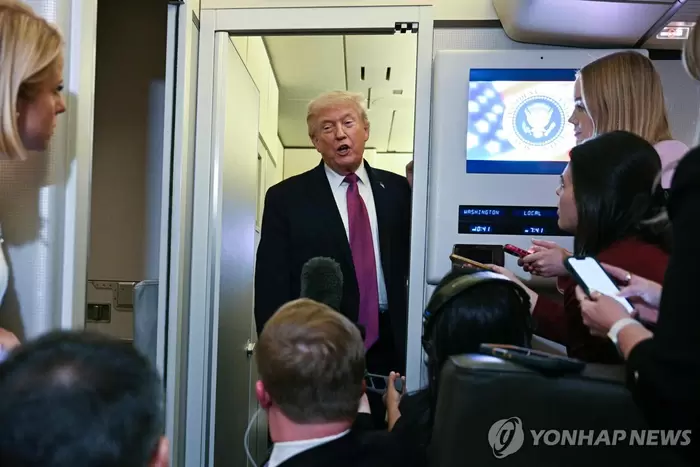
Trump answering reporters' questions
Donald Trump, the US President, made a strong move on the 19th (local time), two days before the end of the ceasefire, by firing upon and seizing an Iranian cargo ship near the Strait of Hormuz.
Before the announcement of the seizure, he urged a deal by threatening to blow up all bridges and power plants. This was to maximize pressure ahead of last-minute talks with Iran, which is at a critical juncture between maintaining negotiation momentum and escalating the conflict.
However, Iran's current stance is that it will not enter negotiations unless the US naval blockade against Iran is lifted, making it uncertain whether talks will be held on the 20th as President Trump claimed.
President Trump announced on his social media platform Truth Social that afternoon that an Iranian cargo ship attempting to breach the US naval blockade in the Gulf of Oman near the Strait of Hormuz was intercepted and taken into US custody.
He also stated that 'a hole was made in the engine room of the Iranian cargo ship.' This suggests that the US Navy fired upon and seized the Iranian cargo ship.
This is the first known instance of the US using force to intercept an Iranian vessel since it began its naval blockade against Iran in the Strait of Hormuz. Previously, several Iranian ships were turned back with warning broadcasts and other means, but no force was reportedly used.
President Trump's decision to 'fire upon and seize an Iranian ship' can be seen as a strong move to pressure Iran into an agreement before negotiations. In response to Iran's demand to lift the naval blockade in the Strait of Hormuz for talks, the US has instead escalated the level of the blockade.
Earlier that day, President Trump announced on Truth Social that his negotiation team for talks with Iran would be in Islamabad, Pakistan, the mediating country, on the 20th.
These negotiations are likely to be the de facto final talks before the ceasefire ends. President Trump stated that if an agreement is not reached this time, he 'will no longer play nice.'
He then warned, 'We have made a very fair and reasonable offer, and we hope they accept it. Otherwise, the United States will destroy all of Iran's power plants and bridges. They will collapse instantly and easily.'
Regarding attacks on civilian infrastructure such as power plants and bridges, Mike Waltz, the US Ambassador to the UN, defended the stance on ABC, stating, 'Attacking and destroying infrastructure that has been used for military dual-purposes is not a war crime.'
The US and Iran seemed to be finding common ground for ending the war on the 17th, with the ceasefire between Israel and Lebanon taking effect and Iran announcing the opening of the Strait of Hormuz.
However, President Trump decided to maintain the naval blockade against Iran centered on Hormuz, and Iran resumed its blockade of Hormuz, deeming it a violation of the ceasefire agreement. Indian ships attempting to pass through were attacked by the Iranian Islamic Revolutionary Guard Corps Navy and forced to turn back.
President Trump claimed, 'Iran decided to fire in the Strait of Hormuz yesterday, which is a complete violation of our ceasefire agreement.'
Strait of Hormuz
As both sides accuse each other of 'violating the ceasefire agreement,' if the US proceeds with attacks on Iranian infrastructure, the war, now in its eighth week, could escalate.
This is because Iran could launch retaliatory attacks targeting the oil infrastructure of Gulf nations that have cooperated with the US, and it could use the Houthi rebels, a pro-Iranian group in Yemen, to blockade the Bab-el-Mandeb Strait, which is both the entrance to the Red Sea and another critical international maritime shipping route.
Ultimately, the world's attention has once again turned to the second round of US-Iran negotiations expected to take place in Islamabad. There is intense interest in whether a dramatic breakthrough can be achieved there.
The key issues are whether Iran will maintain its nuclear program and the export of nuclear materials.
A tug-of-war is also expected over issues such as the opening of the Strait of Hormuz and the lifting of the US naval blockade.
Having confirmed the 'effectiveness' of the naval blockade card against Iran, the US is trying to use it to achieve Iran's 'nuclear abandonment,' while Iran is trying to trade the lifting of the naval blockade against them for the resumption of negotiations. Currently, the gap between the two sides' positions appears clear.
In this situation, President Trump's seizure and firing upon an Iranian ship could further provoke the Iranian military, making the resumption of negotiations unlikely. Although President Trump stated that the US negotiation team would be in Islamabad on the evening of the 20th for talks, Iran has not yet issued a clear statement regarding sending its delegation.
It is reported that in Iran, suspicions are being raised that President Trump might be unilaterally pushing for negotiations on the 20th only to then suddenly resume attacks. Iran's suspicion could be that the US's negotiation-related actions are merely a way to accumulate a 'visible justification' for resuming attacks.
US online media outlet Axios reported that several Iranian officials pointed to the possibility that President Trump's true intention might be to resume the war.
The Israel-Lebanon ceasefire, another pillar of the peace negotiations, is equally unstable. An incident occurred where UN peacekeeping forces (UNIFIL) stationed in Lebanon suffered casualties from gunfire attributed to forces believed to be the pro-Iranian armed group Hezbollah.
Given the intricate challenges that the US and Iran must resolve to reach a peace agreement, some observers suggest that both sides might extend the ceasefire rather than reaching an agreement within a day or two.
Hakan Fidan, Turkey's Foreign Minister and one of the mediating countries, said, 'No one wants a new war to break out after the ceasefire ends next week. I hope the ceasefire will be extended, and I am optimistic.'
In an interview with NBC News, US Ambassador to the UN Waltz responded to a question about extending the ceasefire by saying that everything is on the table, but ultimately it is President Trump's decision.
Newsletter
Get key news delivered to your email every morning
to leave a comment.