
to leave a comment.
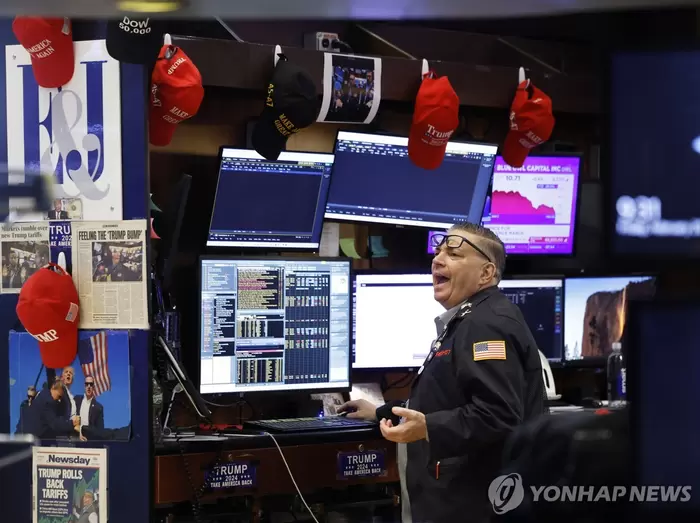
MAGA (Make America Great Again) hat hanging in the trading floor of the New York Stock Exchange (NYSE).
An analysis has emerged that remarks and Truth Social posts by U.S. President Donald Trump are acting as key variables dictating the volatility of the U.S. stock market.
Bloomberg reported on the 25th (local time), citing an analysis by market research firm Fundstrat Research, that the top five 'best days' and 'worst days' for the Standard & Poor's (S&P) 500 index since President Trump took office were all determined by his remarks or posts.
According to the analysis, there has been no instance since the Ronald Reagan administration in 1981 where a specific leader so frequently drove such record market fluctuations.
Normally, economic indicators, the Federal Reserve's (Fed) interest rate decisions, and corporate earnings affect the market, but it is now pointed out that President Trump himself has become a key variable. Consequently, Wall Street's attention has clearly shifted to the President's 'mouth'.
The day the S&P 500 index rose the most during President Trump's current term was April 9 last year, when he temporarily suspended tariff imposition, surging 9.5%. It also rose 3.3% on May 12, when the U.S.-China trade truce agreement was announced.
Conversely, on April 3 last year, when President Trump first implemented comprehensive tariff measures, the index fell by 4.8%, and the following day, it dropped an additional 6% due to news of China's retaliatory tariffs.
This trend was also repeated during the Iran war situation.
Recently, the S&P 500 index recorded its sharpest 'V-shaped' plunge and surge since 2020. On March 30, it fell 9% from its previous high, nearing a technical correction, but rebounded in just 11 trading days to hit an all-time high.
On March 20, when President Trump stated he did not want a ceasefire with Iran, the S&P 500 index fell by 1.5%. On March 31, when he announced that 'negotiations with Iran are progressing smoothly and the war is nearing its end,' the index surged 2.9%, hitting its highest level since May and continuing its upward trend for the week.
This phenomenon is not limited to the stock market. Commodity prices also fluctuated significantly, and oil market volatility surged to levels seen at the beginning of the COVID-19 pandemic.
Alexander Altmann of Barclays pointed out that President Trump's ambiguous stance on the war has made him both an "arsonist and a firefighter" in the market.
Hardika Singh, an economic strategist at Fundstrat, said, "He has the market on a leash," adding, "It's unprecedented for a president to exert such control over the fate of the stock market."
New York Stock Exchange (NYSE)
However, there is also a counterargument that such an analysis is a statistical illusion.
Alexander Altmann of Barclays explained that the average CBOE Volatility Index (VIX) during presidential terms since 1990 was 19.3, which differs from the perception that the market under the Trump administration is more chaotic than before.
There is also an analysis that this is intertwined with the spread of 'passive investment'.
The analysis suggests that as passive funds, which track indices directly, have become mainstream in the market, the market as a whole has become more sensitive to news, whether it's presidential remarks or unexpected earnings.
It is well known that President Trump regards stock prices as a kind of 'report card'. Accordingly, the Trump administration continues its aggressive public relations efforts.
The official White House social media channels upload graphics celebrating new S&P 500 index records, and President Trump even directly advises investors to buy.
Newsletter
Get key news delivered to your email every morning
to leave a comment.