
to leave a comment.
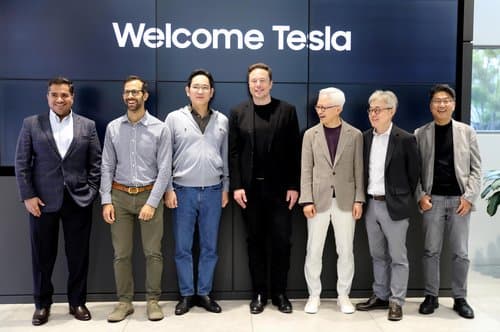
Musk: "AI4 upgrade production depends on Samsung"…Partnership solidified
'Deficit' foundry performance improvement gains momentum…US Taylor factory operation speeds up
Although Samsung Electronics' semiconductor business is breaking new records thanks to the memory boom, analysis suggests it is too early for the foundry (semiconductor contract manufacturing) division to escape the deficit swamp immediately.
However, as Samsung Foundry is expanding its artificial intelligence (AI) chip cooperation with Tesla across the board, the industry's attention is focused on the timing of a full-scale escape from the deficit through the so-called 'Tesla effect'.
According to the industry on the 26th, Elon Musk, CEO of Tesla, stated at an earnings call on the 22nd, "We are planning an upgrade to the company's AI chip 'AI4'," and "Mass production is expected around mid-next year, but it depends on Samsung completing the modification work for us and bringing it to mass production."
This is interpreted as virtually entrusting Samsung Foundry with the overall production of improved AI4 products.
The product is an improved model of the AI4 chip, which Tesla mass-produced in 2023, with enhanced capacity and computational power, and is expected to be named 'AI4+' or 'AI4.1'.
Prior to this, Samsung Electronics had also agreed to produce the next-generation 'AI5' and 'AI6' chips.
In particular, the AI6 order, formalized by CEO Musk in July last year, amounted to approximately 23 trillion won. This was the largest contract for a single customer in Samsung Electronics' semiconductor division, and at the time, it was praised for opening a new path for the struggling foundry business.
With the addition of this AI4 upgrade product order, the partnership between the two companies appears to be further solidified.
Currently, Samsung Electronics is mass-producing the existing AI4 using the 7-nanometer (nm, 1nm = 1 billionth of a meter) process at its Pyeongtaek foundry line. The AI4 upgrade product is also presumed to be manufactured at the Pyeongtaek campus.
In addition, it is understood that AI5 will be produced in shared volumes with Taiwan's TSMC, and AI6 will be solely handled by Samsung Electronics. AI5 and AI6 are expected to be produced using the 2-nanometer advanced process at the Taylor factory in the United States.
AI4, AI5, and AI6 are Tesla's self-developed AI chips for autonomous driving, used in vehicles to enable Full Self-Driving (FSD) capabilities.
The successive orders for Tesla-bound products are interpreted as a result of the trust Samsung Foundry has built with the existing AI4, coupled with the yield and performance of its fine processes being on track.
CEO Musk recently shared news of AI5's 'tape out' via his X (formerly Twitter) account, stating, "Thanks to Samsung Electronics and TSMC for helping us produce this chip."
In line with the tape-out news, the first step in prototype production, the Taylor factory's operation is also gaining momentum.
The Taylor factory, which held an equipment move-in ceremony on the 24th, is expected to begin initial operation by the end of this year, with mass production of Tesla products commencing in earnest next year.
Accordingly, attention is also focused on the timing of performance improvement for Samsung's foundry business division.
Samsung Electronics' preliminary operating profit for the first quarter, disclosed earlier this month, was 57.2 trillion won, with memory accounting for 95% (approximately 54 trillion won), while the non-memory division, including foundry, is estimated to have incurred a deficit of around 1 trillion won.
Above all, the general view is that the Tesla effect is unlikely to be reflected in performance this year.
The watershed for a performance rebound is expected to be after next year, when the US Taylor factory begins operation and Tesla volumes are shipped.
The securities industry estimates that the non-memory division's deficit will reach 3 to 4 trillion won this year. There are also predictions that the deficit could be significantly reduced or turn into a surplus as early as next year.
An industry official explained, "Performance improvement due to Tesla volumes will be fully reflected from the time actual products are shipped," adding, "A significant performance rebound could be seen as early as next year or the year after."
Samsung Electronics is scheduled to announce its detailed first-quarter performance by business division on the 30th.
At the earnings announcement, questions from investors and analysts regarding foundry strategy, including the specific operational timing of the Taylor factory and the status of customer cooperation, are expected to be concentrated.
Newsletter
Get key news delivered to your email every morning
to leave a comment.