
to leave a comment.
WSJ, citing China's rare earth and Iran's Strait of Hormuz as examples, says "US must rally allies to succeed"
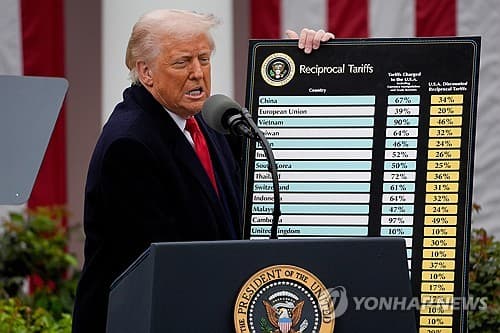
It has been pointed out that US President Donald Trump's preferred tariff policy has not succeeded because it fails to threaten the critical weaknesses of hostile nations.
According to the Wall Street Journal (WSJ) on the 12th (local time), the key variable that determines victory or defeat in various international disputes is 'economic choke points'.
While President Trump appears more actively engaged in various economic disputes than his predecessors, the WSJ analyzes that his method of pressuring other countries has not been effective.
China, which retaliated with restrictions on rare earth exports in a trade war using high tariffs as a weapon, is a prime example.
Faced with China's blockade, which produces over 90% of the rare earths used in various fields from electric vehicles to the aerospace industry, President Trump eventually had to seek a truce in the trade war.
In Iran's case, it countered US and Israeli attacks by threatening to blockade the Strait of Hormuz, through which 20% of the world's crude oil passes.
Iran successfully bought itself time by securing a two-week truce.
Experts believe that these phenomena occurred because maritime routes like the Strait of Hormuz or rare earths acted as economic choke points for the US.
Edward Fishman, a professor at Columbia University who served as a sanctions policy officer at the Treasury Department during the Barack Obama administration, explained that such 'economic choke points' are characterized by market dominance, indispensability, and an asymmetrical damage structure.
He stated that if a specific country holds a dominant position in a supply chain or transportation route and cannot be easily replaced in the short term, it can inflict greater damage on the opposing country.
Conversely, the WSJ points out that President Trump's tariff policy struggles to meet these conditions.
Although the US market is large, its scale is not so absolute that it is impossible for opposing countries to find alternative markets, thus limiting the effectiveness of the pressure, according to the analysis.
Indeed, while China's exports to the US decreased due to US tariffs, the expansion of exports to other regions largely compensated for this.
For this reason, the WSJ emphasized the growing importance of alliances in economic warfare.
It explained that while the US alone may have limited influence, cooperation with allies can combine supply chains, technology, and markets to form much stronger choke points.
In fact, the US is still assessed to possess powerful choke points in the dollar-based financial system and advanced technology sectors.
If the US cooperates with Europe in such areas, the effect could be amplified, but President Trump has shown a preference for an independent approach rather than coordination with allies.
It is also pointed out that by threatening tariffs on Europe, for example, he has shaken relationships and thereby weakened the effectiveness of his choke point strategy.
The WSJ emphasized the importance of alliances, stating, "Alliances can transform limited economic capabilities into overwhelming power."
Newsletter
Get key news delivered to your email every morning
to leave a comment.